


Weeds Watch: A Month-by-Month Calendar
Here are weeds to watch for in your landscape each month.
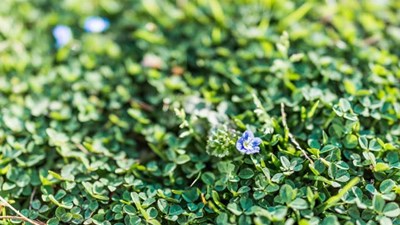
One weed you’re almost sure to encounter sooner or later – especially in the U.S. Northeast and upper Midwest – is corn speedwell. This fast-growing, mat-former with the telltale blue flowers is both a rampant seeder and a plant that’s not terribly picky about where it grows.
Although it’s primarily known as an invader of lawns, corn speedwell also often shows up in landscaped beds, open untended fields, and even carpeting the ground of woodlands.
Corn speedwell is a winter annual broadleaf weed native to Europe and parts of North Africa and Asia. It is common in the U.S. Northeast and upper Midwest but can grow in many regions.
It’s a plant that sprouts from seed primarily in late summer through fall, although some germination happens in very early spring.
The seedlings hug the ground with arms that quickly fan out to create dense mats of half-inch to three-quarters-inch oval leaves that have rounded, toothed edges.
The lowest level of foliage stays about two to four inches tall, but some stems (including the flower stalks) turn upright and can top out around a foot to 14 inches.
Plants grow fastest in the cool weather of early spring, producing the more erect stalks tipped with single blue to pale-blue flowers by late spring into early summer. That’s when corn speedwell is most noticed.
Plants die in the heat of summer after producing small yellow seeds that drop to the ground, setting the stage for a new cycle later that summer and fall.
Common name: Corn Speedwell
Scientific name: Poa annua
Life cycle: Winter annual
Growth habit: Bunch-type grass.
Where it grows: Thin lawns and landscape beds, prefers dry, sandy soils and shady lawns
How it spreads: Seed (heavy seed production)
When it sprouts/emerges: Germinates mainly in late summer to fall
When it flowers or seeds: Flowers in spring to early summer, drops seed in summer
Root type: Fibrous with a short taproot
Key ID features: Low-growing, mat-forming with small, blue-violet, 4-petaled flowers and Small oval leaves with rounded, toothed edges, covered with fine, soft hairs.
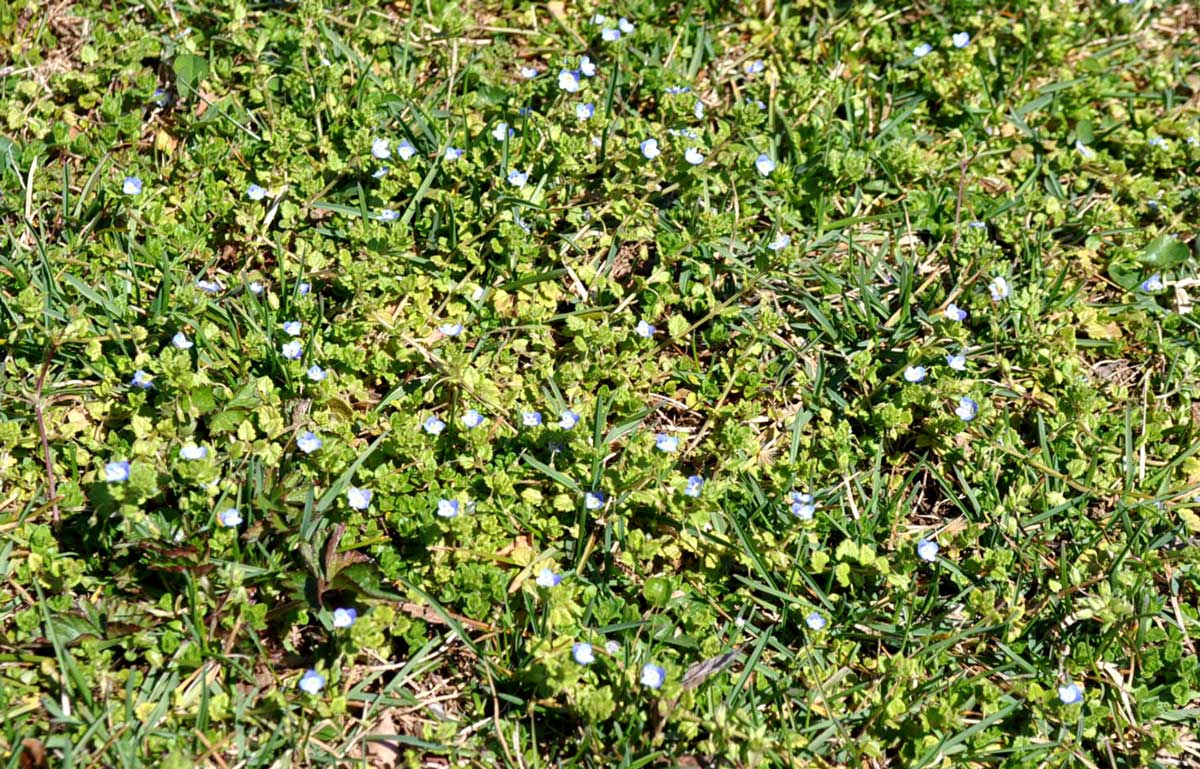
Mats of blue-blooming corn speedwell are dominating this thin lawn in spring. Photo by George Weigel
It is less common in frequently disturbed soil, since young seedlings are easily uprooted.
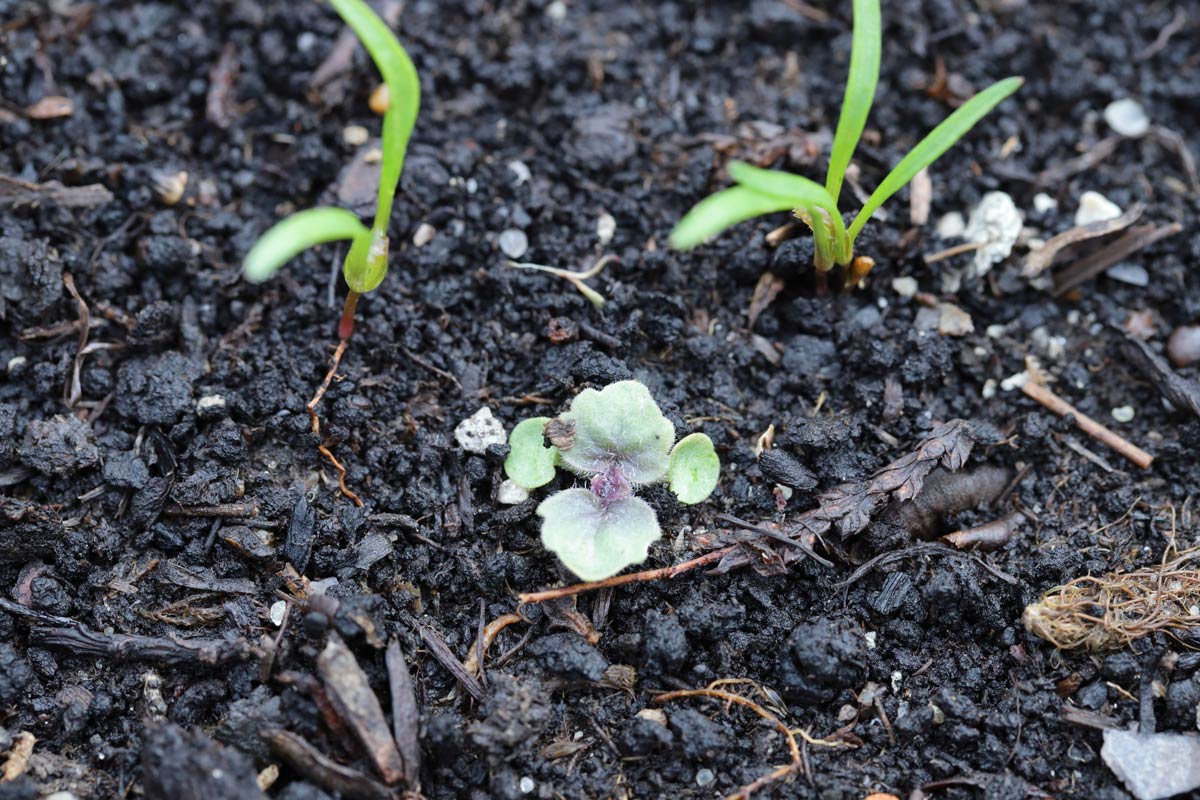
Corn speedwell seedling in fall. KLEJDYSZ TOMASZ / iStock / Getty Images Plus.
Timing matters: understanding the life cycle is critical for effective control.
Because corn speedwell is a winter annual, it depends entirely on reseeding. Preventing seed germination is often more effective than treating mature plants.
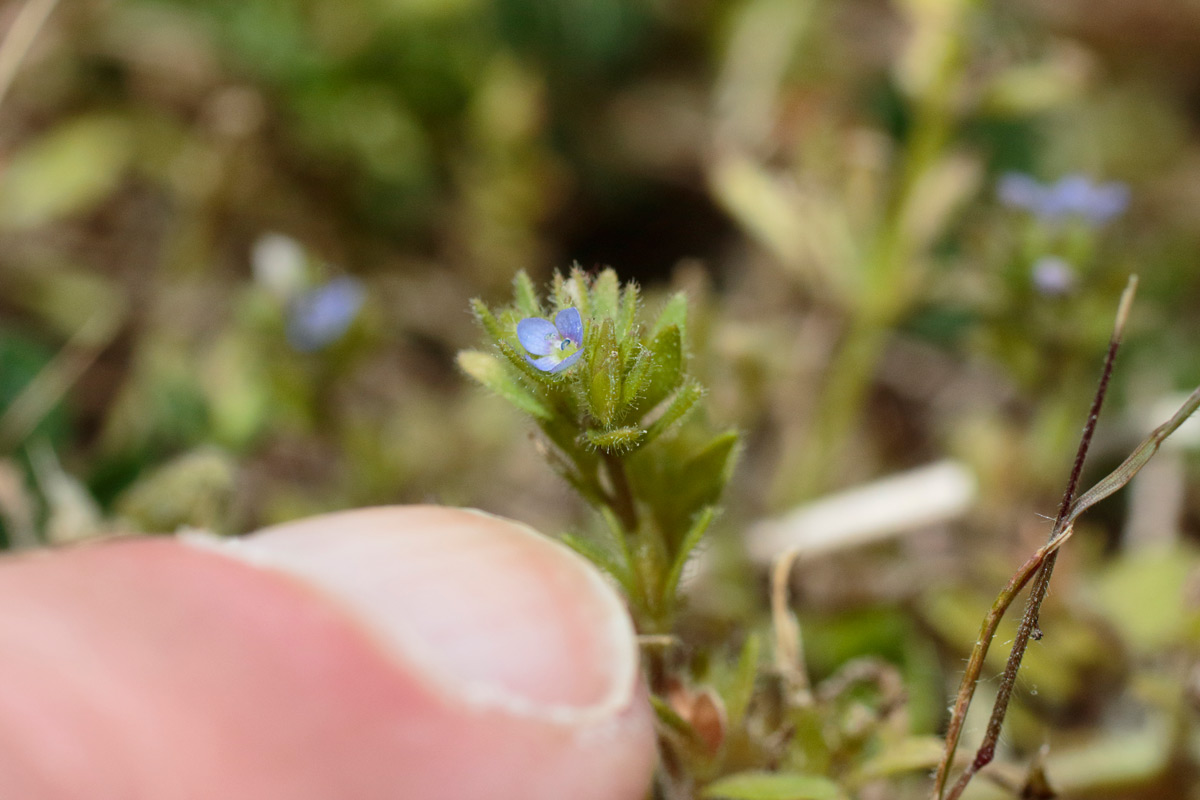
Corn speedwell has tiny blue to violet flowers. Roger Whiteway / iStock / Getty Images Plus.
Landscape beds are prime territory for corn speedwell because soil is often exposed and lightly disturbed. Control strategies differ slightly from lawn management.
Corn speedwell has shallow roots, making it relatively easy to remove when young.
Best timing: Early spring before flowering
Tip: Pull after rainfall or irrigation when soil is moist
Important: Remove plants before they set seed
For larger mats, use a sharp hoe to slice just below the soil surface.
Mulch is one of the most reliable ways to control corn speedwell in flower and shrub beds.
Apply:
Mulch blocks sunlight, preventing seed germination and smothering young seedlings.
Replenish mulch annually, especially in late summer before fall germination begins.
Because corn speedwell germinates in late summer and fall, applying a pre-emergent herbicide listed to control corn speedwell in late summer can significantly reduce next season’s growth.
Look for products labeled for:
Always:
Timing is critical — applications must occur before seeds germinate.
If corn speedwell is already growing in beds:
When spot-spraying:
Non-selective herbicides will damage any green plant they contact, so precision is essential in flower and shrub beds.
Corn speedwell often appears in thin or weak turf, especially in early spring when its small blue flowers stand out against the grass. In lawns, control focuses on both removing existing plants and preventing new ones from germinating.
Long-term control focuses on eliminating conditions that favor germination.
In Flower and Shrub Beds:
In Lawns:
Because corn speedwell is a winter annual that germinates in late summer and fall, prevention is key, as is maintaining a thick, healthy lawn. Dense, vigorous grass naturally crowds out corn speedwell, limiting the light and space seedlings need to establish.
Corn speedwell is often confused with other Veronica species:
Correct identification ensures proper treatment timing.
Best time to prevent corn speedwell: Late summer (before fall germination)
Best time to remove existing plants: Early spring before flowering
Most effective bed prevention method: 2–3 inches of mulch
Why it returns each year: Seed production and fall germination
Corn speedwell may look delicate with its small blue flowers, but it spreads quickly in landscape beds and lawns if left unchecked. The combination of:
…provides reliable, long-term control.
If you focus on prevention in late summer and eliminate seedlings early in spring, you can keep flower beds and shrub borders largely free of corn speedwell year after year.